
Folegandros
Folegandros is a compact western Cycladic island of about 32 square kilometres, wedged between Milos and Santorini and rising sharply from the Aegean to a high point of 455 metres. Its three main communities feel distinctly different: Chora sits dramatically around a medieval Kastro on a cliff roughly 200 metres above the sea, Karavostasis is the small port below, and elongated Ano Meria runs across the windswept northwest, where old agricultural houses known as themonies are still scattered among fields and dry-stone walls.
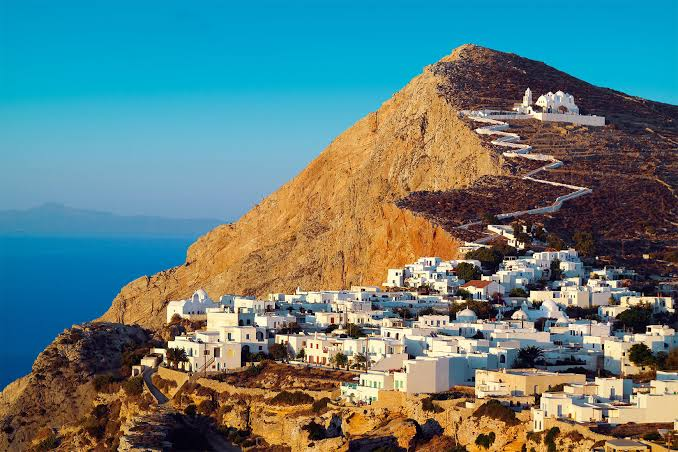
The landscape is the real story here: steep cliffs, dry hills and old footpaths lead down towards beaches such as Agali, Livadaki and the famously wild Katergo, while the 20-kilometre network of historic trails crosses much of the island between chapels, farms and isolated coves. Folegandros has developed enough to have lively squares, restaurants and places to stay, but its character remains unusually grounded in the landscape — you can spend the morning wandering the lanes of Chora, walk across the agricultural country of Ano Meria in the afternoon, and finish above the sea at the Panagia church watching the sunset over an island that still feels distinctly rugged rather than resort-built.
Clifftop Cycladic charm without the big-island bustle
Folegandros is a particularly strong fit if you want a beautiful Cycladic island that combines genuine quiet with a memorable village, dramatic scenery and good walking. Chora sits dramatically on a cliff around 200 metres above the sea, with its medieval Kastro, whitewashed lanes, small squares and traditional cafés, while the island’s extensive old paths cross hills, farmland, stone walls and remote coastline. Beaches such as Katergo, Livadaki and Fira retain a much wilder character than the main village, and the island’s official tourism material describes Folegandros as a place for people wanting to distance themselves from everything and explore on foot. It is therefore more than a beach destination: the combination of spectacular Chora, rugged cliffs, hiking and secluded coves gives it a distinctive slow-paced Cycladic character. :contentReference[oaicite:0]{index=0}
Quiet, but no longer a secret
The important nuance is that Folegandros should not be mistaken for an undiscovered or completely undeveloped island. Chora becomes lively on summer evenings, with tavernas and bars filling its squares, while accessible beaches such as Agali and Livadi can be popular in summer and have accommodation, tavernas, cafés or other facilities nearby. :contentReference[oaicite:1]{index=1} The quieter side of Folegandros is found by walking beyond the easiest beaches: Katergo has no food or water access and requires either a boat or a roughly 30-minute walk, while Livadaki requires a 45–60 minute hike from Ano Meria or a boat from Agali. Those beaches can deliver the wild, isolated experience people associate with Folegandros, but they also demand preparation, particularly because shade, water and other facilities are absent. :contentReference[oaicite:2]{index=2}
Sources
- visitgreece.gr – Folegandros | Quiet western Cyclades island, dramatic cliffs, Chora at approximately 200 metres, Kastro, beaches, hiking trails and peaceful character
- discovergreece.com – Discover the hiking paths of Folegandros | Extensive traditional walking network, quiet landscape, old local paths, remote beaches and clifftop scenery
- discovergreece.com – 10 best things to do in Folegandros | Chora’s summer atmosphere, tavernas and bars, Agali’s popularity, beaches, hiking and local character
- folegandros.gr – Katergo Beach | Wild beach, difficult land access, no food or water, walking and boat access
- folegandros.gr – Livadaki Beach | Remote beach, 45–60 minute hiking routes from Ano Meria, boat access from Agali, no food or water
- folegandros.gr – Agali Beach | Accessible popular beach, accommodation, tavernas, cafés, mini market and local bus/road/boat access
Back to all Greek islands
The Greek Island Directory is a project of passion where a love of Crete, Data Integrity and Directories converge to create something truly special for users: Learn More.
Last Updated on August 28, 2026 by admin