Amorgos
Amorgos is the easternmost Cyclade, a long, thin spine of mountain dropping sheer into the sea, and it feels like the edge of the Cyclades in the best way. Most people know it because of The Big Blue, but the island itself is much deeper than that film — stark, spiritual, wind-battered.
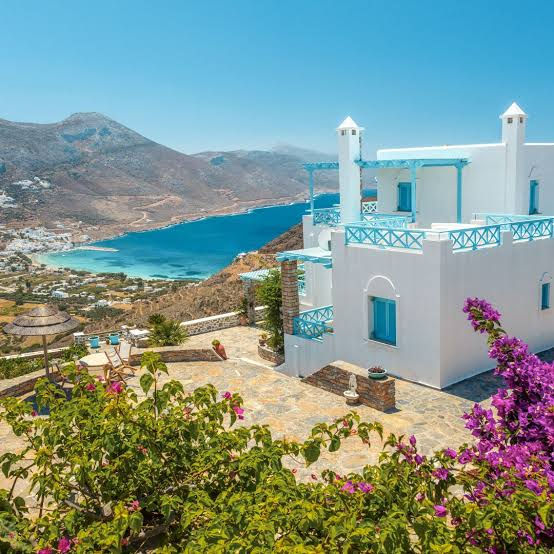
It is defined by two things: the monastery of Panagia Hozoviotissa, whitewashed and glued to a cliff 300 meters above the sea like it’s defying gravity, and the endless blue that surrounds it. You stay in Chora, a perfect Cycladic village high up with windmills and cats and views forever, or down in Aegiali or Katapola by the ports. Days are hiking the old mule paths that criss-cross the island, swimming at Agia Anna and Mouros where the water is dark blue and bottomless, eating fava and raked goat dishes that taste like the rocks they graze on. Amorgos doesn’t try to please everyone. It’s dry, slow, and honest — the kind of island you either get immediately or leave too soon.
For the deep-blue seekers and trail lovers
You’ll click here if you like your swims dramatic and your days a bit wild. Think cliff-hanging monasteries like Panagia Hozoviotissa clinging to the rock above the Aegean, that is your morning hike and your viewpoint in one. The beaches are all about that Big Blue feeling, Agia Anna with the two rocks from the film, Mouros with caves you can swim into, Agios Pavlos with Nikouria islet just offshore, and Aegiali bay that is probably one of the prettiest beach villages in the Cyclades. It’s popular with young, educated, alternative Greeks, hikers, divers, and people who love free camping on secluded spots half an hour from Aegiali, not resort crowds. There are no hotel resorts, just family rooms and small hotels, so you get real tavernas and quiet harbours in Katapola and Aegiali. If you want untouched by mass tourism, imposing sea views, ancient footpaths in steep rocky terrain, and water that feels bottomless, this is it. Less ideal if you want big sandy stretches, loud nightlife, or everything on your doorstep, the island is long and you’ll be moving between Chora, Katapola and Aegiali.
Making the journey smooth
Getting there is part of why it stays quiet. No airport, ferry only. Main route is Piraeus, 5 to 9 hours depending on conventional or high-speed, Blue Star is around 6 to 8 hours, Seajets faster at 4 to 5 hours. Easiest move many do is 07:30 Piraeus to Naxos then 14:00 Express Skopelitis Naxos to Amorgos, except Sundays when Skopelitis doesn’t run that leg. Late departure at 17:30 direct arrives around 01:00, so not ideal unless you have to. You’re also connected daily in summer to the Small Cyclades, Donousa, Koufonisia, Schinousa, Iraklia, plus Ios, Santorini, Naxos, Paros, Mykonos. Best for beaches is June to September, warmest sea, calmer mornings. Best for hiking is April, May and late September to October, cooler, 20 to 25 degrees, trails way nicer, and you avoid the 35 degree peaks of summer heatwaves. Winter is desolate and many places shut. Stay choice matters, Katapola is harbourside and handy for ferries, Chora is photogenic up top with sunset views, Aegiali is best for beaches and hiking starts. Bring proper hiking shoes, not just flip-flops, a light wind layer, and cash for the smaller tavernas. Book a room with a harbour view in August, it fills, and build in a buffer night on Naxos if you’re connecting from Santorini or Ios, connections can be tight.
Sources
- internationalliving.com – Hiking Island of Greece | Summer best for beaches June-September, year-round for hiking but colder in winter, not too overcrowded
- solotravelerworld.com – Solo Travel Amorgos | Off beaten track, no airport, no hotel resorts, popular among alternative Greeks, filming location Le Grand Bleu, free camping near Aegiali
- takemetogreece.com – Amorgos Island Guide | Getting there regular or high-speed ferries from Athens Santorini, best beaches Agia Anna, Agios Pavlos, Mouros, Aegiali
- greeceinsiders.travel – How to get to Amorgos | No airport arrive by sea, Piraeus 6-8 hours conventional 4-5 hours high-speed catamaran
- allovergreece.com – How to get to Amorgos | Ferry served by Blue Star Ferries, Cyclades Lines Naxos-Amorgos, Seajets, connections to Small Cyclades and other Cyclades
Back to all Greek islands
The Greek Island Directory is a project of passion where a love of Crete, Data Integrity and Directories converge to create something truly special for users: Learn More.
Last Updated on August 26, 2026 by admin