Gavdos
Gavdos is Greece’s southernmost island, lying about 45 kilometres south of Crete across the Libyan Sea, and at roughly 30 square kilometres it is large enough to feel wild without ever feeling crowded. There is no conventional town: Kastri is the administrative centre, while Sarakiniko, Korfos, Vatsiana and Ambelos are tiny settlements scattered through pine and juniper-covered hills, with dirt tracks, low scrub and isolated houses making much of the island feel remarkably remote.
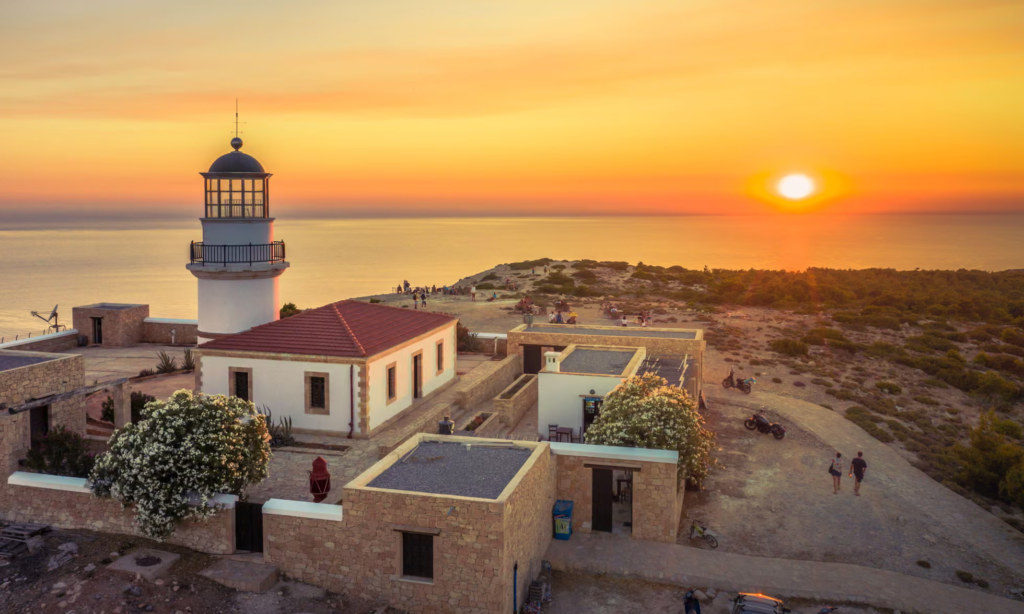
The beaches are the obvious draw, but Gavdos is more about the landscape between them: Sarakiniko has broad golden sand and dunes, Agios Ioannis is backed by juniper and cedar, and Trypiti marks the southernmost point of Greece with the famous chair perched above the sea. Much of the island remains undeveloped and difficult to traverse quickly, so days here tend to revolve around walking dusty tracks, swimming from quiet coves, eating simply in small tavernas and watching the Libyan Sea stretch away from an island that feels genuinely separated from the rest of Greece.
Crete’s wild southern outpost
Gavdos is an unusually strong choice if you want genuine isolation, wild beaches and a slower way of living rather than a conventional Greek island holiday. It is Europe’s southernmost inhabited island and its character is defined by nature: cedar forests, dunes, rocky coastline, remote coves and old footpaths connecting scattered settlements and beaches. Agios Ioannis, Sarakiniko, Lavrakas, Korfos and Tripiti each offer a different version of the island’s famously unpretentious coastline, while hiking gives you access to places that are difficult to reach by road. Gavdos also has a long-established reputation for freedom and alternative living, and several beaches have traditionally had a relaxed attitude towards nudism. If your ideal island means spending the day walking through cedar country, swimming at a quiet beach and watching the sunset rather than chasing attractions, Gavdos is one of Greece’s clearest fits.
The wildness is real, and so are the limitations
Gavdos is not simply a quiet beach resort with fewer people; much of its appeal depends on the absence of conventional infrastructure. There are small accommodation businesses, tavernas, mini markets, vehicle rentals and a bus service, but supplies and services remain limited compared with Crete, and the island is entirely dependent on sea connections. The most remote beaches can require substantial walking, and summer heat makes some trails considerably more demanding than their distances suggest. The island is also environmentally sensitive: the entire island lies within the Natura 2000 network, with protected cedar-dune habitats that are particularly vulnerable to careless camping and foot traffic. Free camping has historically been an important part of Gavdos culture, but visitors should not assume that every traditional camping practice is automatically permitted or environmentally acceptable. This is a place where preparation, self-sufficiency and respect for the landscape matter considerably more than they would on a developed resort island.
Sources
- visitgreece.gr – Gavdos Georoutes | Southernmost edge of Europe, isolation, tranquillity, cedar forests, dunes, beaches, hiking routes, Tripiti, Agios Ioannis, Sarakiniko and relaxed natural-living culture
- gavdos.gr – Municipality of Gavdos | Island character, nature, tranquillity, freedom and location at the southern edge of Europe
- gavdos.gr – Gavdos Walking Trails | Hiking network, trail distances and difficulty, remote beaches, cedar-dune habitats and Natura 2000 protection
- gavdos.gr – Beaches of Gavdos | Sarakiniko accommodation and services, tavernas, mini markets and beach information
- gavdos.gr – Settlements and Sights | Karave harbour, accommodation, tavernas, cafés, mini market, vehicle rental, bus service and Kastri infrastructure
- gavdos.gr – Municipal Camping and Environmental Information | Restrictions concerning caravans and use of beaches, forests and public areas, environmental protection
- gavdos.gr – Municipality statement on protected areas | Lavrakas–Agios Ioannis environmental protection and need for clear rules in sensitive areas
Back to all Greek islands
The Greek Island Directory is a project of passion where a love of Crete, Data Integrity and Directories converge to create something truly special for users: Learn More.
Last Updated on August 28, 2026 by admin