Rhodes
Rhodes is one of Greece’s largest and most historically layered islands, sitting at the crossroads of the Aegean and eastern Mediterranean, where ancient Greek, medieval, and modern influences overlap with a strong tourism economy, long sandy beaches, and a mix of resort areas and working towns that give it both scale and substance beyond a typical holiday island.
Overview
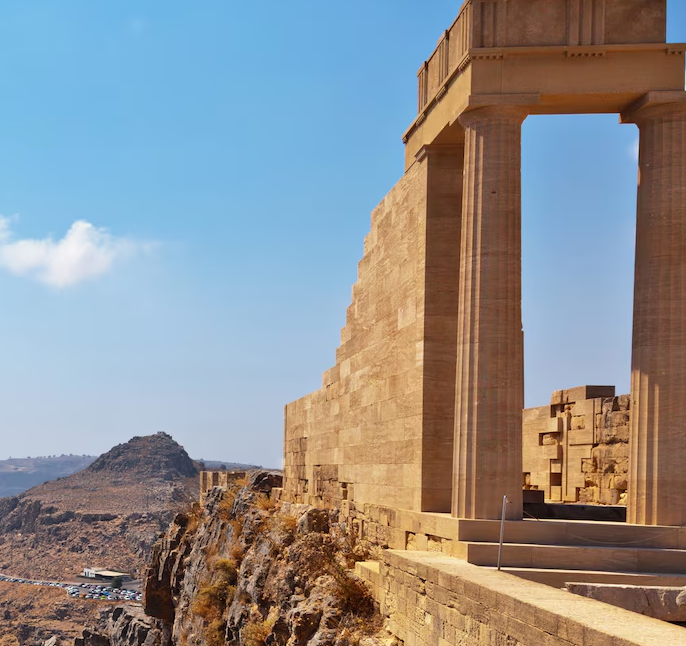
Rhodes has been inhabited since antiquity and became one of the most important centres of the ancient Greek world, known for its maritime power and the Colossus of Rhodes, one of the Seven Wonders of the Ancient World, while the island’s strategic location made it a key hub for trade and cultural exchange across the eastern Mediterranean.
At Akrotiri, a Bronze Age town preserved under volcanic ash, you can still see multi-storey buildings, frescoes, and surprisingly advanced infrastructure, pointing to a well-developed society with strong trade links, while in later periods the island (then Thera) was part of wider Greek expansion, including the founding of Cyrene in North Africa.
Rhodes remained under Ottoman rule until the early 20th century, when it passed to Italian control before being incorporated into the modern Greek state after World War II, with its long history reflected in everything from ancient ruins to medieval walls and neoclassical architecture.
Today, Rhodes is one of Greece’s most visited islands, known for its combination of large-scale tourism, extensive beaches, and major historical sites, with a travel profile that ranges from high-energy resort areas to quieter villages and a year-round local population that supports a more balanced, functioning island economy.
| Name | Rhodes • Ρόδος • Ródos |
| Demonym | Rhodian |
| Dialect | Standard Modern Greek (Dodecanese variety with minor regional features). |
| Islands Group | Dodecanese |
| Sea Group | Aegean Sea |
| Vibe | Large, diverse, and tourism-driven; mixes historic sites, resort zones, and working towns. |
| Tourism Level | Very high and strongly seasonal, with peak in July–August. |
| Cost | Mid-range overall; wide range from budget to luxury depending on area. |
| Best Months | May–June and September–October offer warm weather with fewer crowds. |
| Wind | Moderate–strong; influenced by Meltemi winds, especially on the west coast. |
| Beach Type | Mix of sandy and pebbled beaches; calmer sandy beaches often on the east coast. |
| Food | Greek and Dodecanese cuisine with local specialties and strong Mediterranean influence. |
| Nightlife | Active in areas like Faliraki and Rhodes Town; quieter elsewhere. |
| Family-Friendly | Very; many resorts, beaches, and facilities suitable for families. |
| Access | International airport and frequent ferries from Piraeus and other islands. |
| Transport | Extensive bus network, taxis, and private transfers across the island. |
| Car Rental | Widely available and recommended for exploring beyond main resorts. |
| Roads | Well-developed main road network; good overall condition. |
| Walkability | Moderate; high in Rhodes Town, low elsewhere due to scale. |
| Connectivity | Good mobile and internet coverage across most areas. |
| Infrastructure | Well-developed; major tourism hub with strong services and facilities. |
| Healthcare | Major hospital in Rhodes Town and regional clinics. |
| ATM | Widely available in towns and tourist areas. |
| Accommodation | Extensive range from large resorts and all-inclusive hotels to boutique stays. |
| Typical Stay | Commonly 4–7 days. |
| Population | 115,490 |
| Expat Community | Moderate and international, largely linked to tourism. |
| Property and Living | Active property market with both local housing and holiday homes; more accessible than top-tier islands. |
| Size | ~1,401 km² |
| Geography | Large island with varied terrain including mountains, forests, and long coastlines. |
| Elevation | Highest point ~1,216 m (Mount Attavyros). |
| Culture | Ancient Greek foundations layered with medieval (Knights of St John), Ottoman, and Italian influences, visible in architecture and urban layout. |
Back to Islands
Similar Islands:
Crete • Corfu • Kos • Zakynthos • Lesbos
Under:
- Historic Greek islands | Lively Greek islands | Diverse Greek islands
- Greek islands with Very High Tourism
- Best Greek islands to visit in: May | June | July | August | September | October
- Greek islands Accessible By Boat
- Greek islands Accessible By Ferry
- Greek islands With Domestic Airports
- Greek islands With International Airports
- Greek islands with over 100,000 people
The Greek Island Directory is a project of passion where a love of Crete, Data Integrity and Directories converge to create something truly special for users: Learn More.
Last Updated on July 16, 2026 by admin