Mykonos
Mykonos is a small Cycladic island in the Aegean that historically lived in the shadow of nearby Delos—one of the most important religious and trade centres in ancient Greece—later passing through Byzantine, Venetian, and Ottoman control and playing a minor but noted role in the Greek War of Independence, and while it was once a relatively poor, wind-exposed island with limited agriculture, today it’s globally recognised for its whitewashed towns, sandy beaches, and tourism-heavy identity built around nightlife, luxury travel, and strong seasonal demand.
Overview
Named after the mythological figure Mykons, Mykonos has been inhabited since at least the Neolithic period and later became part of the wider Greek world, though it largely sat in the shadow of nearby Delos, which was a major religious and trade centre, with Mykonos playing more of a supporting role in the region.
After Delos declined in the 1st century BCE, Mykonos carried on as a small, fairly low-profile island through the Hellenistic and Roman periods, later moving under Byzantine and then Venetian control (from the 13th century), when settlements and basic defences developed mainly as a response to piracy in the Aegean.
Under Ottoman rule, the island kept a degree of local autonomy and maritime activity and played a part in the Greek War of Independence—especially through Manto Mavrogenous—before becoming part of the modern Greek state, remaining for much of its history a poor, wind-exposed island with limited farming due to dry conditions and scarce natural resources.
Settlement is concentrated along the caldera rim (e.g., Fira, Oia) as a direct adaptation to volcanic topography, while the island’s beaches (black, red, white) reflect differing volcanic compositions; historically, Santorini passed through Byzantine, Venetian (as “Santorini,” from Santa Irini), and Ottoman control before integration into the modern Greek state, with its layered geology, preserved archaeology, and distinctive landscape underpinning its contemporary cultural and tourism significance.
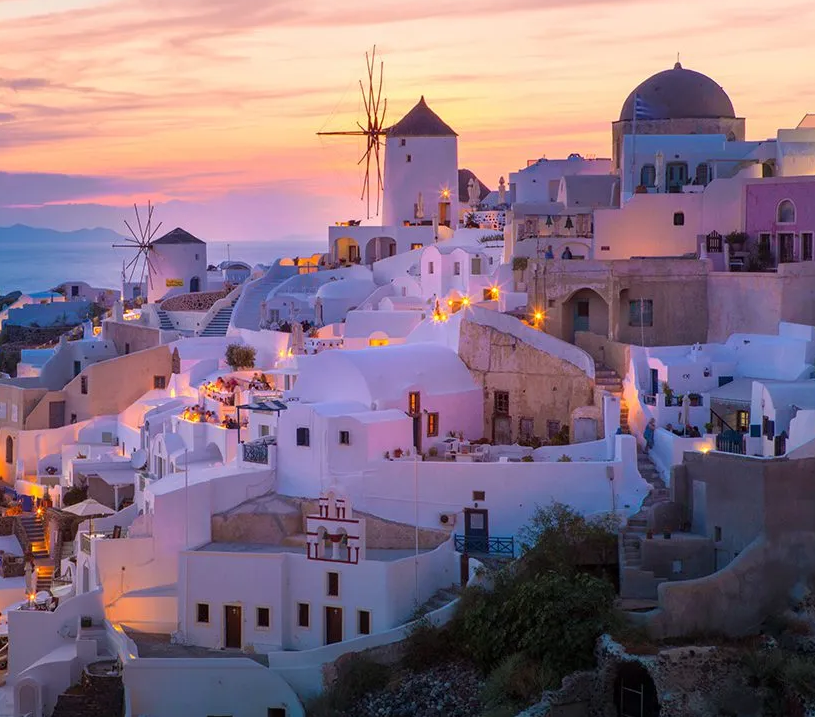
Today, Mykonos is one of Greece’s most internationally recognised islands, defined by its dense concentration of tourism infrastructure, sandy beaches, and iconic built environment (including windmills and the waterfront of Little Venice), with a global reputation for nightlife and luxury travel, strong seasonal population surges, and an economy almost entirely oriented around high-volume tourism.
| Island | Santorini | Θήρα | Thíra | Thera |
| Demonym | Mykonian |
| Dialect | Standard Modern Greek (Cycladic variety with minor regional features). |
| Islands Group | Cyclades (Southern Cyclades subgroup) |
| Sea Group | Aegean Sea |
| Vibe | Cosmopolitan, high-energy, and tourism-driven, combining luxury travel, nightlife, and international party culture. |
| Tourism Level | Very high and strongly seasonal, with peak influx in July–August. |
| Cost | High to very high, particularly in peak season and for beachfront or central accommodation. |
| Best Months | May–June and September offer warm weather with fewer crowds than peak summer. |
| Wind | Moderate–strong; heavily affected by the Meltemi winds during summer. |
| Beach Type | Mostly sandy beaches, many organised with beach clubs and amenities. |
| Food | Seafood-focused cuisine with local specialties such as kopanisti (spicy soft cheese) and louza (cured pork). |
| Nightlife | Very active; internationally known clubbing scene with beach clubs and late-night venues. |
| Family-Friendly | Limited in peak season due to nightlife focus; more suitable in shoulder seasons and quieter areas. |
| Access | International airport and frequent ferries from Piraeus, Rafina, and other Cyclades islands. |
| Transport | Bus network, taxis, private transfers; congestion common in summer. |
| Car Rental | Widely available; useful for accessing beaches and less central areas. |
| Roads | Paved but often narrow; high traffic volumes during peak season. |
| Walkability | Partially walkable (high within Mykonos Town, limited elsewhere). |
| Connectivity | Good mobile and internet coverage, especially in tourist areas. |
| Infrastructure | Well-developed for tourism but under pressure during peak season (transport, water, waste). |
| Healthcare | Local health centre and clinics; more advanced care accessed via mainland Greece. |
| ATM | Widely available in main towns and tourist zones. |
| Accommodation | Extensive range from luxury villas and boutique hotels to mid-range and budget options; strong premium segment. |
| Typical Stay | Commonly 2–4 days, often combined with other Cyclades islands. |
| Population | ~10,700 permanent residents (2021 census, ELSTAT; Municipality of Mykonos). |
| Expat Community | Moderate and international, largely tied to tourism and hospitality sectors. |
| Property and Living | High-value real estate market driven by international demand; strong short-term rental sector. |
| Size | ~85.5 km² |
| Geography | Relatively low-relief island with rocky terrain, limited vegetation, and numerous bays forming natural beaches. |
| Elevation | Highest point ~364 m (Mount Prophet Elias). |
| Culture | Ancient Greek roots (named after Mykons), later Byzantine and Venetian influence, with modern identity shaped by tourism and proximity to Delos, a major archaeological and religious site in antiquity. |
Back to Islands
Similar Islands:
Paros • Rhodes • Corfu • Zakynthos • Ios
Under:
- Scenic Greek islands, Lively Greek islands, Diverse Greek islands
- Best Greek islands to visit in: May, June, July, August, September;
- Greek islands Accessible By Boat
- Greek islands Accessible By Ferry
- Greek islands With Domestic Airports
- Greek islands With International Airports
- Greek islands with Very High Tourism
- Greek islands with over 10,000 people
The Greek Island Directory is a project of passion where a love of Crete, Data Integrity and Directories converge to create something truly special for users: Learn More.
Last Updated on July 16, 2026 by admin