
Greek islands with History
Greek islands with history are spread throughout Greece, where centuries of ancient, Byzantine, Venetian, Ottoman, and maritime influence have shaped settlements, architecture, and cultural landscapes. These islands often contain archaeological sites, historic towns, fortifications, monasteries, and long-standing local traditions that reflect their strategic and cultural importance across different historical periods.
| Island — Description |
|---|
| Crete — The strongest overall historical island in Greece because it contains the core of Minoan civilisation alongside major Byzantine, Venetian, Ottoman, and modern Greek historical layers, with Knossos alone giving the island world-historical importance. |
| Delos — One of the most historically important islands in the entire Aegean and arguably Greece’s single greatest archaeological island because of its central role in ancient Greek religion, mythology, trade, and classical civilisation. |
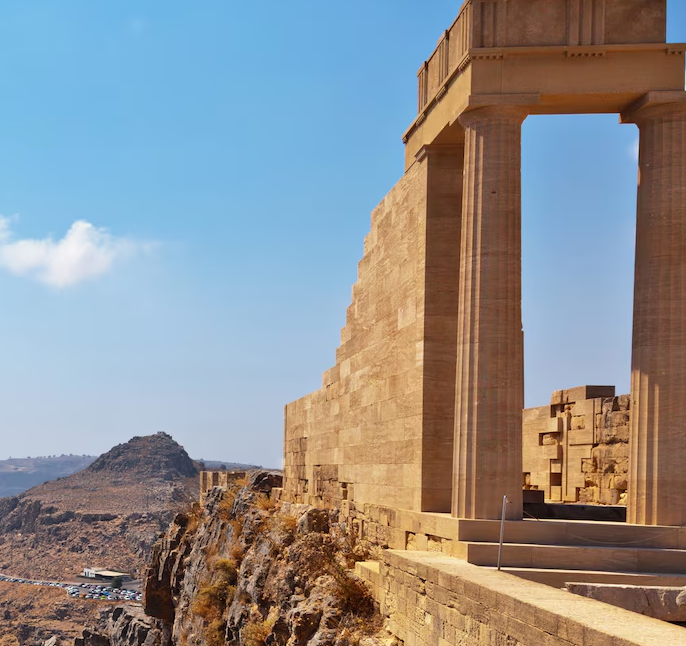
| Rhodes — One of the most visibly historical islands in Greece because of its medieval city, crusader fortifications, Knights Hospitaller legacy, Ottoman layers, and ancient remains. |
| Kos — Historically major through Hippocrates, ancient medicine, Roman ruins, medieval fortifications, and strategic Dodecanese history. |
| Corfu — Exceptionally layered historically through Venetian, French, British, and Ionian influences, with one of Greece’s most distinctive historical urban identities. |
| Patmos — One of Christianity’s most important islands because of the Cave of the Apocalypse and Monastery of Saint John. |
| Chios — Major medieval and maritime historical island with Genoese villages, monasteries, and long-standing commercial importance. |
| Lesbos (Lesvos) — Deep literary, philosophical, Byzantine, Ottoman, and cultural history extending from antiquity to modernity. |
| Samos — Historically major because of Pythagoras, the Heraion, ancient engineering achievements, and strong classical Greek significance. |
| Naxos — One of the most historically layered Cycladic islands through antiquity, Venetian rule, ancient temples, mountain villages, and medieval heritage. |
| Paros — Important historically because of ancient marble production, Cycladic civilisation, Byzantine churches, and Venetian influence. |
| Tinos — Historically significant through religion, pilgrimage culture, marble craftsmanship, and Venetian-era heritage. |
| Syros — One of the strongest modern-historical islands because Ermoupoli became a major 19th-century commercial and industrial centre of Greece. |
| Hydra — Historically central to the Greek War of Independence and maritime trade networks. |
| Spetses — Another key island in the Greek War of Independence with preserved naval and maritime heritage. |
| Santorini — Historically crucial because of Akrotiri and the Bronze Age volcanic eruption, despite modern tourism often overshadowing its archaeology. |
| Kefalonia — Strong Venetian and Ionian historical identity with meaningful maritime and wartime history. |
| Kythira — Historically important through Venetian influence and strategic maritime positioning between regions. |
| Leros — Significant modern military and WWII historical importance. |
| Kalymnos — Historically important through sponge-diving traditions and maritime culture. |
| Karpathos — Preserves unusually strong traditional culture and historical continuity. |
| Amorgos — Historically important through monastic heritage and long Cycladic continuity. |
| Ikaria — Strong political and social historical identity, especially linked to exile history and alternative culture. |
| Skyros — Historically significant through mythology, regional identity, and traditional Aegean culture. |
| Samothrace — Historically important because of the Sanctuary of the Great Gods and ancient mystery cults. |
| Limnos — Strong mythological and military history, especially through Lemnian mythology and Gallipoli-era importance. |
| Ithaca — Mythologically foundational because of Odysseus and the Homeric tradition. |
| Evia — Historically important because of its size, strategic position, and long settlement continuity. |
| Chalki — Small but historically layered through maritime and sponge-diving traditions. |
| Kastellorizo — Historically important frontier island with Ottoman, Italian, and eastern Mediterranean significance. |
As old as time:
Greek islands with history are best suited to travellers and prospective residents who value cultural depth, continuity, and a sense of connection to the past alongside everyday island life. Historically rich islands typically combine archaeology, traditional architecture, long-inhabited settlements, and visible layers of different civilisations, creating environments that feel more grounded and multidimensional than purely tourism-focused destinations. For travellers, this supports slower, more engaging holidays where beaches, walking, museums, local culture, and exploration naturally coexist. For residents, historical depth often contributes to stronger identity, year-round community life, and a more meaningful sense of place beyond seasonal tourism. The trade-off is that historically important islands can feel more structured, regulated, or busy around key cultural areas, especially in peak season. They’re less suited to travellers seeking pure nightlife or fully isolated escapes. Overall, historic islands suit people who value atmosphere, heritage, and long-term cultural interest over intensity or simplicity alone.
Back to Categories
Dive deeper:
Temples / Archaeology / Ruins
- Greek islands with with temples
- Greek islands with archaeological sites
- Greek islands with ruins
- Greek islands with the best ruins
- Greek islands with ancient ruins
- Ancient Greek islands
- Best Greek islands for Historical sites
General History
- Old Greek islands
- Oldest Greek islands
- Important Greek islands
- Greek islands with most historical sites
- Greek islands with the Most History
- Best Greek islands for History buffs
Mythology
Religious / Spiritual History
Historical Settlements / Architecture
Historical Events / Special Historical Associations
The Greek Island Directory is a project of passion where a love of Crete, Data Integrity and Directories converge to create something truly special for users: Learn More.
Last Updated on June 10, 2026 by admin